
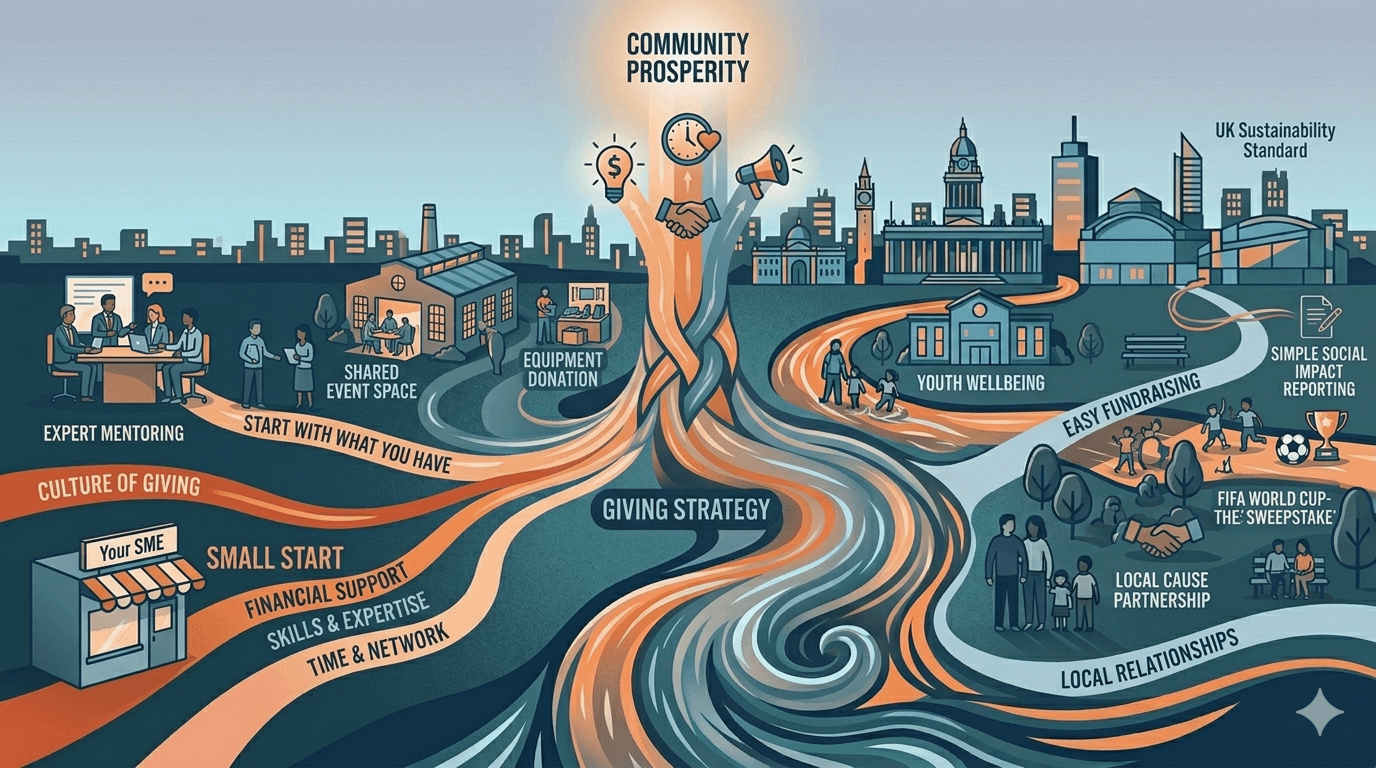
How to Start a Giving Strategy Without a Dedicated CSR Department
Across Leeds, businesses support charities and community organisations in all sorts of ways.
They sponsor local events, organise fundraising activities, volunteer their time and donate to causes that matter to their employees, customers and communities. Much of this happens quietly. It rarely forms part of a formal strategy and it often sits alongside the day-to-day demands of running a business.
Yet these activities have something important in common. They demonstrate the role businesses can play beyond their commercial objectives and the positive contribution they can make to the places where they operate.
For organisations looking to build on those efforts, the next step is often not doing more. It is being more intentional about how they give, who they support and the impact they want to create.
The good news is that this does not require a dedicated CSR department, a sustainability manager or a significant budget. Some of the most effective giving strategies begin with a small team, a local cause and a commitment to making a difference within the community around them.
Start With What You Already Have
When businesses think about charitable giving, the conversation often turns immediately to money.
Financial support is important, particularly given many charities continue to face financial pressures, but it is only one part of the picture.
Every organisation already has resources that can create value for charities and community organisations. That might be expertise within the team, access to suppliers and customers, marketing support, event space, equipment or simply a group of people willing to get involved.
Before deciding what budget to allocate, it is worth considering what already exists within the business and how those assets might be used to support local causes.
A professional services firm may be able to offer mentoring or specialist advice. A marketing agency could help a charity reach new audiences. A manufacturer might support fundraising activities through facilities, logistics or supplier relationships.
The most successful giving strategies often begin by identifying these existing strengths and finding practical ways to use them.
Make Giving Part of Your Culture
Many businesses can point to a fundraising event they organised several years ago or a charity initiative they supported during a particular campaign.
While those activities have value, they tend to create the greatest impact when they form part of an ongoing approach rather than remaining isolated events.
That does not mean creating a complex programme or introducing formal policies from day one.
It could be as simple as choosing a charity partner for the year, supporting a local organisation each quarter or giving employees opportunities to nominate causes that matter to them.
Over time, these activities help build a culture where giving back becomes part of how the organisation operates rather than something that happens occasionally.
They also tend to generate stronger engagement from employees. People are often more motivated to support initiatives when they can see a clear connection between the cause, the business and the community around them.
Fundraising Doesn't Need To Be Complicated
One of the reasons some businesses delay charitable activity is the assumption that fundraising requires a major event or significant investment.
In reality, some of the most effective fundraising activities are also the simplest.
Sponsored walks, charity quizzes, raffles, auctions and bake sales continue to raise substantial amounts for good causes because they are easy to organise and encourage broad participation.
The most successful events are usually those that fit naturally with the culture of the business.
For some organisations, that may be a networking event with charitable fundraising built in. For others, it may be a team challenge, a community event or a fundraising initiative linked to a wider campaign.
The format matters less than creating something people genuinely want to participate in.
When employees, customers and suppliers feel connected to a cause, even relatively small activities can create meaningful results.
Use Major Events To Bring People Together
One of the easiest ways to encourage participation is to build fundraising around events that people are already interested in.
With the FIFA World Cup taking place this year, many workplaces will already be discussing fixtures, predictions and results. That creates a natural opportunity to raise money while bringing colleagues together.
A simple sweepstake remains one of the most effective fundraising tools available. Entry fees can be donated to a chosen charity, while prediction competitions and tournament leaderboards can help maintain engagement throughout the competition.
The same principle can apply to other sporting events, local festivals, charity awareness days and community celebrations throughout the year.
Fundraising is often most successful when it feels like a shared experience rather than an additional obligation.
Build Relationships With Local Charities
For businesses looking to create a longer-term giving strategy, local partnerships are often a good place to start.
Leeds is home to hundreds of charities, community organisations and social enterprises working on issues ranging from youth support and homelessness to wellbeing, education and community development.
Building relationships with local organisations helps businesses better understand the challenges facing their communities and provides opportunities to see the impact of their support first-hand.
Many charities are not simply looking for one-off donations. They are looking for long-term supporters, advocates and partners who can contribute in different ways over time.
For businesses, those relationships often create a stronger sense of connection than supporting causes further afield, because the impact can be seen within the communities where employees, customers and stakeholders live and work.
Why Social Impact Is Becoming More Important
For most SMEs, charitable giving is not driven by reporting requirements.
It is driven by a desire to contribute positively to the communities that support their success.
However, it is also true that expectations around responsible business practices continue to evolve.
The UK Sustainability Reporting Standards were published in 2026 and are currently available for voluntary use, while mandatory reporting requirements are being developed for larger listed organisations. At the same time, many SMEs are increasingly being asked to provide information about sustainability, social value and community impact as part of procurement exercises, supply chain relationships and customer requirements.
For smaller businesses, this should not be viewed as a compliance exercise.
Instead, it presents an opportunity to formalise activities that are often already taking place and demonstrate the positive role the business plays within its community.
Start Small. Start Somewhere.
The most effective giving strategies rarely begin with a formal department or a detailed policy document.
More often, they begin with a conversation.
A team deciding to support a local cause. A fundraising idea that gains momentum. A business owner looking for a practical way to give something back.
Over time, those individual activities can become part of the culture of an organisation. They create opportunities for employees to engage with their communities, strengthen relationships with local charities and help businesses contribute to something beyond their day-to-day operations.
The important thing is not creating the perfect strategy from the outset.
The important thing is starting.
Because no business is too small to make a positive contribution, and every organisation has something it can offer to the communities around it.

