
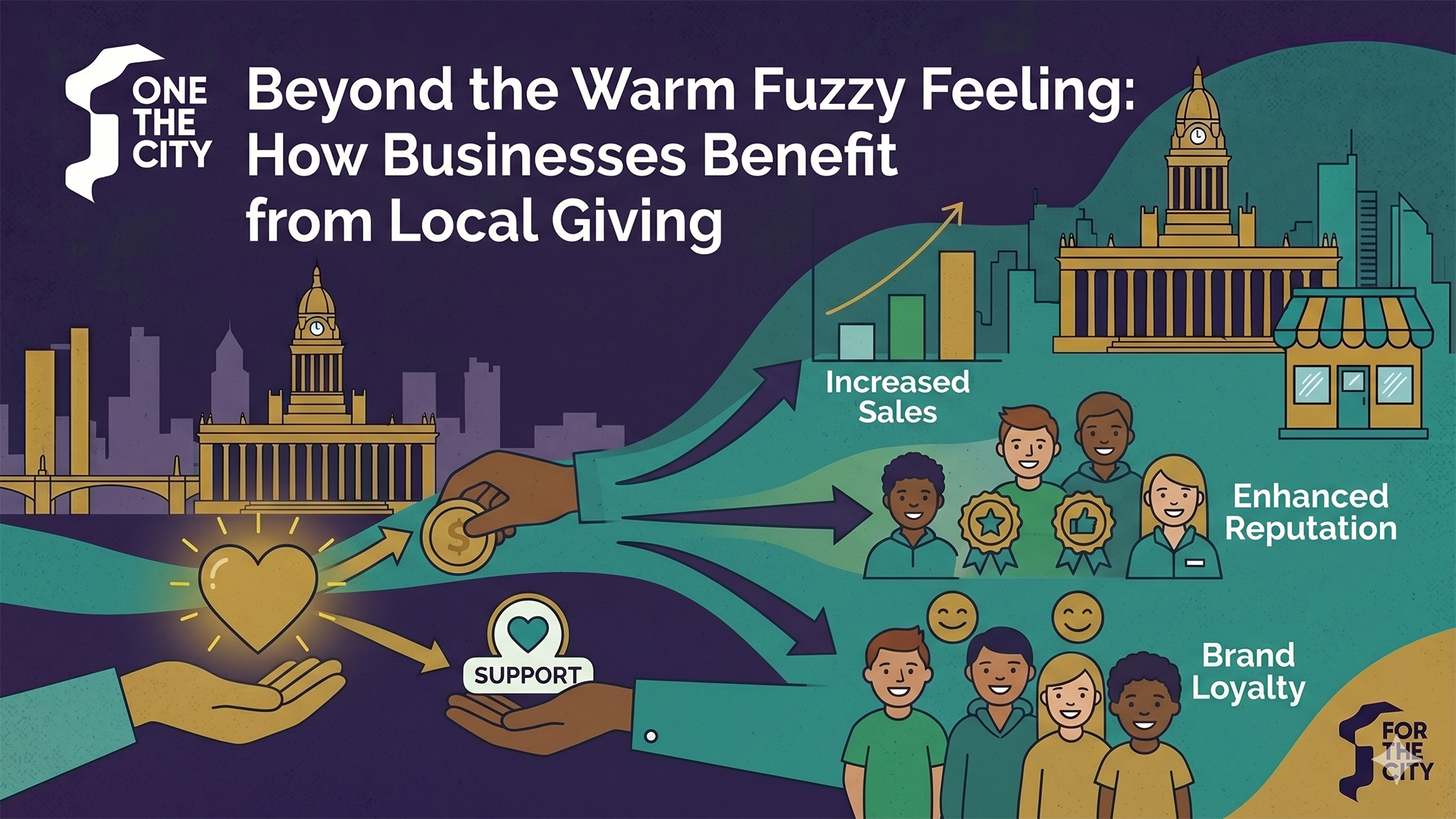
Beyond the Warm Fuzzy Feeling: How Businesses Benefit from Local Giving
At One for the City, giving is often talked about in terms of impact, and rightly so. Supporting organisations doing important work across Leeds matters.
But there is also a more practical side to local giving that is sometimes overlooked.
For businesses, being part of a local giving network is not just about contribution. It is also about connection. It creates a way of engaging with the city, and with other organisations, that is difficult to replicate elsewhere.
A More Connected Business Community
When businesses commit to giving locally, they are not doing it in isolation.
Through One for the City, member organisations become part of a wider group of businesses that are all contributing to the same goal. That shared starting point tends to change the nature of interactions.
There is already a level of alignment. People are in the room for a similar reason, which makes conversations more straightforward and often more useful. It removes some of the usual friction that can come with traditional networking.
Over time, this builds familiarity. Businesses begin to recognise each other, understand what others do, and become more aware of where there might be overlap.
A Different Kind of Networking
Traditional networking can sometimes feel transactional. Conversations are often shaped around what someone needs at that moment.
Local giving shifts that slightly.
Meeting through a shared commitment to Leeds creates a different context. There is less immediate pressure to sell or promote, and more space to listen and understand.
That does not mean there is no commercial benefit. It just tends to develop more gradually. Relationships form first, and opportunities tend to follow.
For many member organisations, that leads to more considered partnerships, introductions that make sense, and collaborations that are based on a clearer understanding of each other’s work.
Relationships That Last
One of the more practical benefits of local giving is the quality of the relationships that come out of it.
When businesses meet regularly through a shared initiative, there is more opportunity to build familiarity over time. Conversations do not need to start from scratch each time.
That consistency matters. It allows relationships to develop at a more natural pace, without the need for constant follow-up or formal structure.
For SMEs in particular, where time and resources are limited, this kind of ongoing connection can be more valuable than sporadic, one-off interactions.
Creating Space to Meet
Part of this comes from simply creating opportunities for people to spend time together.
Throughout the year, we bring member organisations together through events and informal meetups. These are designed to be straightforward. A chance to hear from the organisations being supported, meet others involved, and spend time in the same room.
They are not designed to be overly structured or overly polished. The focus is on creating space for conversation.
Upcoming events will continue to build on that, giving members more opportunities to connect, stay involved in the work happening across the city, and maintain those relationships over time.
Staying Close to the Work
Another difference is that these interactions are not separate from the work being supported.
Events often include time with the organisations receiving funding, or opportunities to hear directly from them. That helps keep the focus grounded.
It also provides a clearer sense of where contributions are going, and what they are enabling. That shared understanding adds another layer to conversations between businesses.
It is not just about what each organisation does commercially, but also what they are collectively contributing to.
A Practical Value, Alongside the Purpose
Local giving will always be about supporting communities first.
At the same time, it also creates a more connected business environment. One where organisations are more aware of each other, more likely to collaborate, and more engaged with what is happening locally.
That has a practical value.
For businesses, it means access to a network that is already aligned around something meaningful. For the city, it means stronger connections between the organisations operating within it.
That combination is part of what makes local giving work, not just for the organisations being supported, but for the businesses involved as well.

